> ## Documentation Index
> Fetch the complete documentation index at: https://docs.occtoo.com/llms.txt
> Use this file to discover all available pages before exploring further.
# Find destinations
> Browse the destinations in the environment, filter them by publish status, and see what each tile tells you.
A **destination** is an API that serves your unified data to something outside Occtoo — a storefront, a marketplace feed, an agent. Each destination holds one or more **API versions**, and it is always a version you open, configure and publish.
 ## Filter and sort
| Control | Options |
| ------------------------------ | ---------------------------------------------------------------------- |
| **Sort by** | Last updated (newest or oldest first), Name ascending, Name descending |
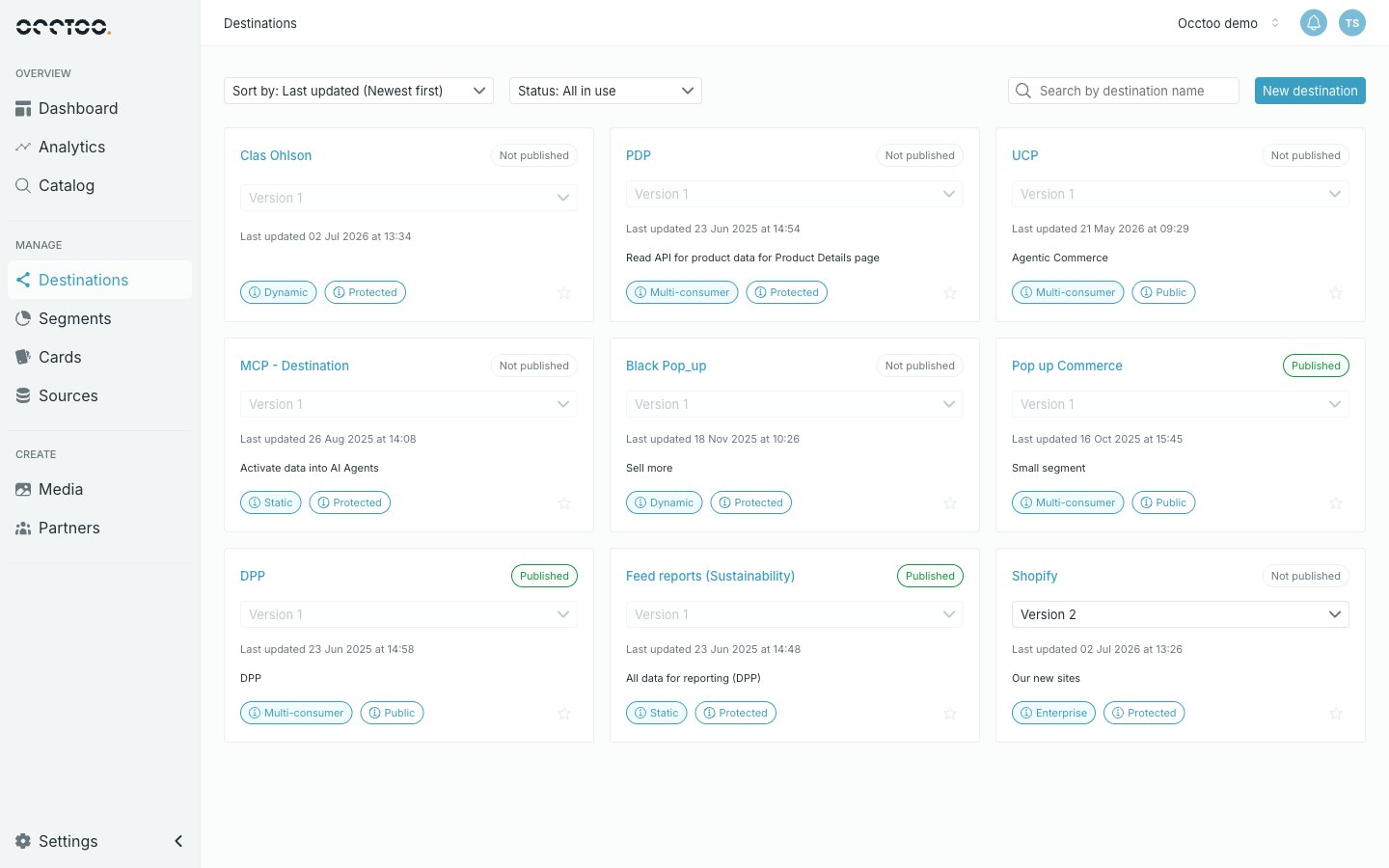
| **Status** | All in use, Not published, Publishing, Published, Publish failed |
| **Search by destination name** | Matches the display name |
**All in use** is the default and covers everything except versions that are deleted or being deleted.
## What a tile shows
Each tile carries the display name, the status of the selected version, a version selector, when it was last updated, the description, and two badges — the destination type and whether the API is **Protected** or **Public**.
The version selector on the tile changes which version's status you are looking at without leaving the listing. It is disabled when the destination has only one version.
Destination types differ in how data is served and how many client applications they allow. See [Destination types](/concepts/destination-types).
## Statuses
| Status | Meaning |
| ------------------- | -------------------------------------------------------------------------------------------------- |
| **Not published** | Never published. The APIs cannot be called yet |
| **Publishing** | Publish in progress |
| **Operational** | Accepting updates, but not all data has reached the endpoints yet |
| **Updating** | A partial publish is running; it returns to Published when infrastructure and mappings are updated |
| **Published** | Live and callable |
| **Pending changes** | Published, with saved changes that are not published yet |
| **Publish failed** | The publish did not complete |
| **Stopped** | Halted because a card schema broke. Fix the query and create a new version |
## Who can do what
Anyone can browse destinations, open a version and read its documentation, analytics and settings.
Creating destinations and versions, editing endpoints, managing languages, registering applications and deleting all need the **Contributor** role or higher — a **Reader** sees the same screens with those controls disabled. Publishing is a separate permission again; if **Publish** is disabled for you while other controls are not, that is why.
See [Users and roles](/guides/studio/settings/users-and-roles).
## Filter and sort
| Control | Options |
| ------------------------------ | ---------------------------------------------------------------------- |
| **Sort by** | Last updated (newest or oldest first), Name ascending, Name descending |
| **Status** | All in use, Not published, Publishing, Published, Publish failed |
| **Search by destination name** | Matches the display name |
**All in use** is the default and covers everything except versions that are deleted or being deleted.
## What a tile shows
Each tile carries the display name, the status of the selected version, a version selector, when it was last updated, the description, and two badges — the destination type and whether the API is **Protected** or **Public**.
The version selector on the tile changes which version's status you are looking at without leaving the listing. It is disabled when the destination has only one version.
Destination types differ in how data is served and how many client applications they allow. See [Destination types](/concepts/destination-types).
## Statuses
| Status | Meaning |
| ------------------- | -------------------------------------------------------------------------------------------------- |
| **Not published** | Never published. The APIs cannot be called yet |
| **Publishing** | Publish in progress |
| **Operational** | Accepting updates, but not all data has reached the endpoints yet |
| **Updating** | A partial publish is running; it returns to Published when infrastructure and mappings are updated |
| **Published** | Live and callable |
| **Pending changes** | Published, with saved changes that are not published yet |
| **Publish failed** | The publish did not complete |
| **Stopped** | Halted because a card schema broke. Fix the query and create a new version |
## Who can do what
Anyone can browse destinations, open a version and read its documentation, analytics and settings.
Creating destinations and versions, editing endpoints, managing languages, registering applications and deleting all need the **Contributor** role or higher — a **Reader** sees the same screens with those controls disabled. Publishing is a separate permission again; if **Publish** is disabled for you while other controls are not, that is why.
See [Users and roles](/guides/studio/settings/users-and-roles).