> ## Documentation Index
> Fetch the complete documentation index at: https://docs.occtoo.com/llms.txt
> Use this file to discover all available pages before exploring further.
# See what a destination is built on
> The cards and segments a version depends on, and why that matters before you change them.
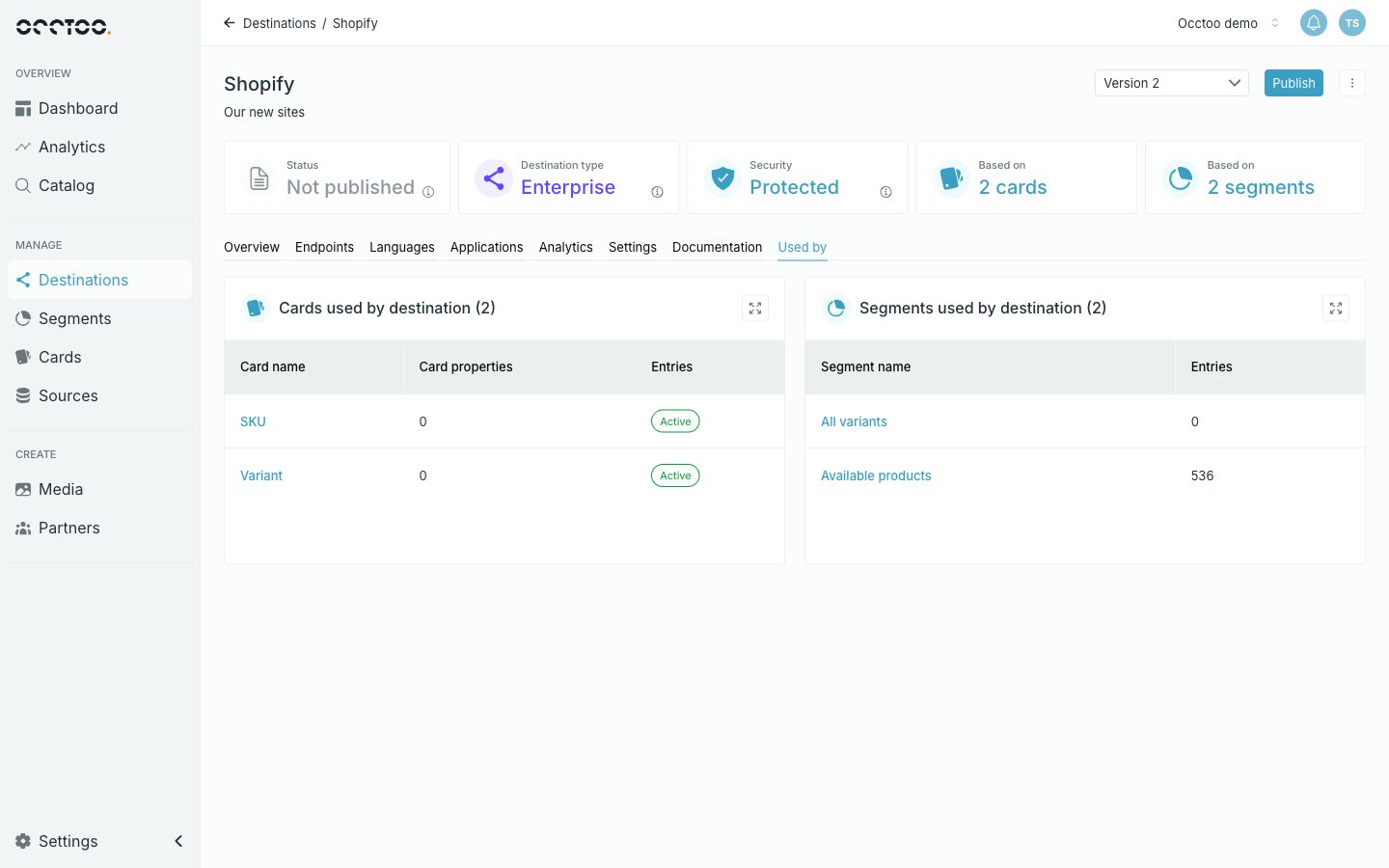
The **Used by** tab lists what this version draws from: **Cards used by destination** and **Segments used by destination**, each with its own count.
 | Table | Columns |
| -------- | -------------------------------------------- |
| Cards | Card name, number of card properties, status |
| Segments | Segment name, number of entries |
Names link to the card or segment, and the expand icon opens a table full-screen.
The same counts appear as **Based on** cards in the destination header.
## Why it matters
Changing a card or segment listed here changes this API. Removing a property from the card removes it from the response; narrowing a segment removes entries from the endpoint — without anyone republishing the destination.
A card that is not **Active** also blocks publishing this version, so check the status column when **Publish** is disabled.
The reverse view exists too: a card shows which destinations consume it, and a segment the same. See [Track usage of a card](/guides/studio/cards/track-usage) and [Track usage of a segment](/guides/studio/segments/track-usage).
| Table | Columns |
| -------- | -------------------------------------------- |
| Cards | Card name, number of card properties, status |
| Segments | Segment name, number of entries |
Names link to the card or segment, and the expand icon opens a table full-screen.
The same counts appear as **Based on** cards in the destination header.
## Why it matters
Changing a card or segment listed here changes this API. Removing a property from the card removes it from the response; narrowing a segment removes entries from the endpoint — without anyone republishing the destination.
A card that is not **Active** also blocks publishing this version, so check the status column when **Publish** is disabled.
The reverse view exists too: a card shows which destinations consume it, and a segment the same. See [Track usage of a card](/guides/studio/cards/track-usage) and [Track usage of a segment](/guides/studio/segments/track-usage).